Drop a recording here or select a file from the device.
Popular audio and video formats acceptedA practical Dutch audio to text converter should make recordings easier to read, search, review, caption, and share.
Work with recordings from the Netherlands and Belgium. Clear speech, good microphones, and separated speakers give the strongest starting point.
Use timestamps and speaker labels to find a quote again. The transcript stays connected to the part of the recording that produced it.
Dutch compounds, names, acronyms, and specialist terms can be reviewed in context, so corrections are quick and easy to trace.
Create a readable transcript, subtitle file, or English text version. Keep the original Dutch wording available for checks and approvals.
| SpeechText.AI | Google Cloud | Amazon Transcribe | Microsoft Azure | OpenAI Whisper | Amberscript (NL) | Speechmatics | |
|---|---|---|---|---|---|---|---|
| Dutch accuracy / WER | 94-96% (4-6% WER; internal estimate/placeholder, no public Dutch benchmark) | 88-92% (8-12% WER; estimate/placeholder, Google Cloud documentation does not publish a Dutch WER) | 86-90% (10-14% WER; estimate/placeholder, Amazon documentation does not publish a Dutch WER) | 88-93% (7-12% WER; estimate/placeholder, Azure documentation does not publish a Dutch WER) | 87-93% (7-13% WER; estimate/placeholder, informed by Radford et al., 2022, not a hosted-vendor test) | 90-95% (estimate/placeholder, Amberscript product materials; Dutch WER method not published) | 87-92% (8-13% WER; estimate/placeholder, Speechmatics documentation has no public Dutch WER) |
| Supported formats | Common audio and video formats | WAV, FLAC, MP3, OGG and more | FLAC, M4A, MP3, MP4, OGG, WAV, WebM | WAV, MP3, OGG and more | Common formats through FFmpeg | Common audio and video formats | Common audio formats |
| Domain models | Yes, including Legal, Medical, Finance and Education | General, long-form and telephony models | General models; custom options vary by language | Custom Speech training available | General multilingual model | General model with human-review options | General model with entity features |
| Speech translation | Dutch speech to English text and subtitles | Translation workflow through Cloud Translation | Translation workflow through Amazon Translate | Speech Translation service | English translation task available | Translation options available | API workflow or connected service |
| Free technical support | Free email support | Documentation and community | Documentation and community | Documentation and community | Community resources | Plan-based support | Plan-based support |
Accuracy context: Common Voice Dutch 17.0 and FLEURS Dutch are reference datasets, but the estimates above are not scores from one controlled vendor run, so no shared sample size applies. Fair WER scoring should lowercase text, remove punctuation, normalize numerals, and standardize apostrophes. Sources: Mozilla Common Voice; FLEURS, Conneau et al. (2023); Robust Speech Recognition via Large-Scale Weak Supervision, Radford et al. (2022); vendor documentation named in the table.
A simple workflow for audio transcripts, video captions, and Dutch-to-English text
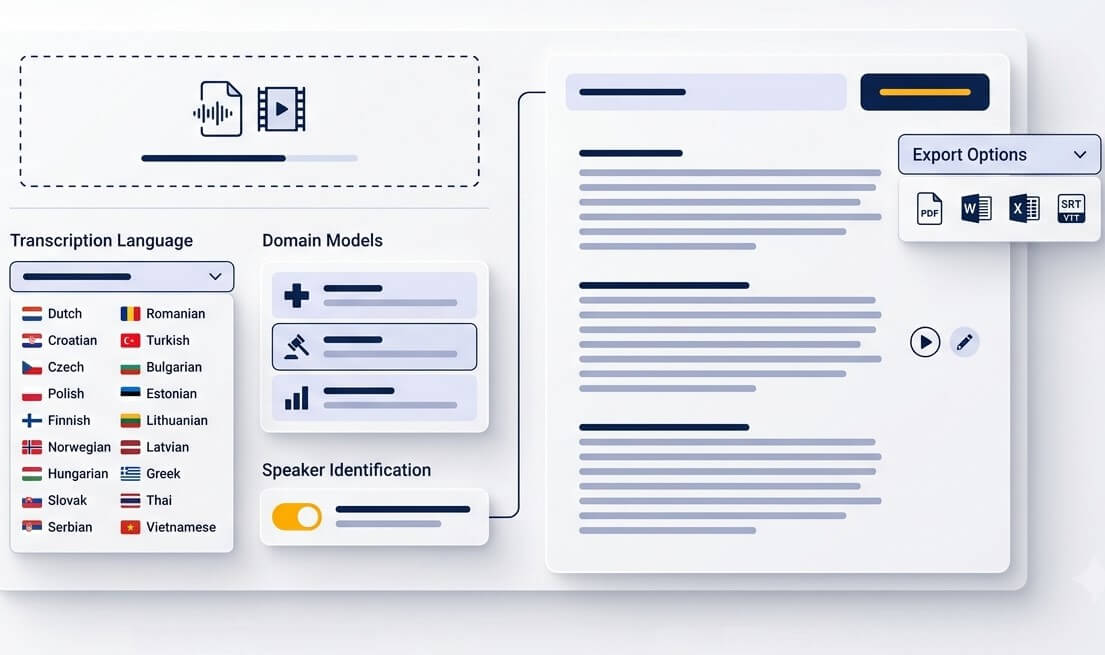
Upload an MP3, M4A, WAV, MP4, WEBM, OGG, OPUS, or another common format. The original recording usually produces better text than an audio file that has been repeatedly forwarded or compressed.
Choose Dutch for speech recognition, then decide whether the project needs a readable transcript, time-coded captions, or an English translation for international readers.
Check names, specialist terms, speaker changes, and punctuation in the editor. Export the finished work as text, Word, PDF, or SRT when it is ready to circulate.
Turn conversations, lessons, voice notes, and video into text that can be searched and shared
Transcribe Dutch interview audio into a working draft, then search themes, mark quotes, and return to the time code when a passage needs checking.
Give teams a written record of Dutch discussions. A transcript helps locate decisions, action points, and the part of the meeting where they were made.
Convert a recorded college, training session, or presentation into notes that are easier to revisit than a long audio file.
Need a Dutch video ondertiteling service for social content, training, or explainers? Start with a transcript and export an SRT caption file for the edit.
Save Dutch voice notes from a phone and turn them into readable text. This is useful when listening is inconvenient or a message needs to be documented.
Prepare Dutch material for colleagues abroad with an English text version. Review Dutch names, locations, and product terms before sharing the translation.
A searchable transcript helps teams work from evidence rather than memory
Create an organized draft from hearings, interviews, and internal reviews. For formal filings, evidence, or sensitive records, a qualified reviewer should verify the final wording.
Use time-coded Dutch transcripts to code interviews, review field recordings, and make lecture content more accessible for participants and students.
Read Dutch customer calls and feedback sessions at speed. Written records make it easier to compare recurring problems, language, and requests across projects.
Speech recognition creates a strong draft. Review turns it into a dependable record for real people and real decisions.
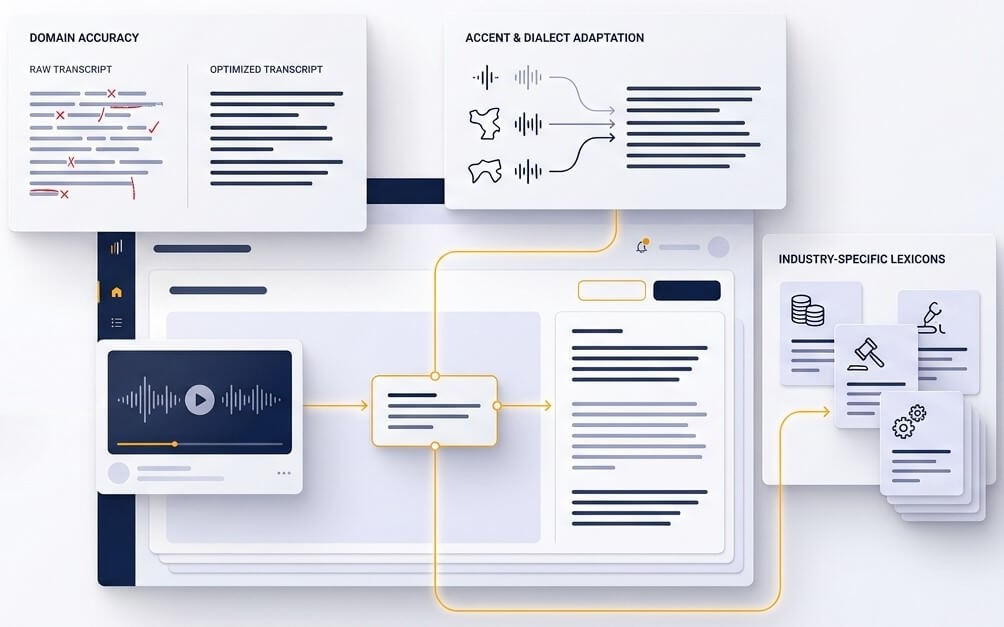
In Dutch, meaning often depends on the surrounding sentence. Compound words, abbreviations, place names, and words shared with English can be difficult in fast speech. Recordings from Flanders may also contain different pronunciation and vocabulary from recordings made in the Netherlands. Audio transcriptie Nederlands works best when the source language, subject, and expected names are clear from the start.
A close microphone, limited room noise, and one person speaking at a time can reduce later editing. If several people share a room, identify speakers early and keep the original file where possible. Heavy overlap, music, phone compression, and unclear names can affect every transcription system, so important passages should always be checked against the audio.
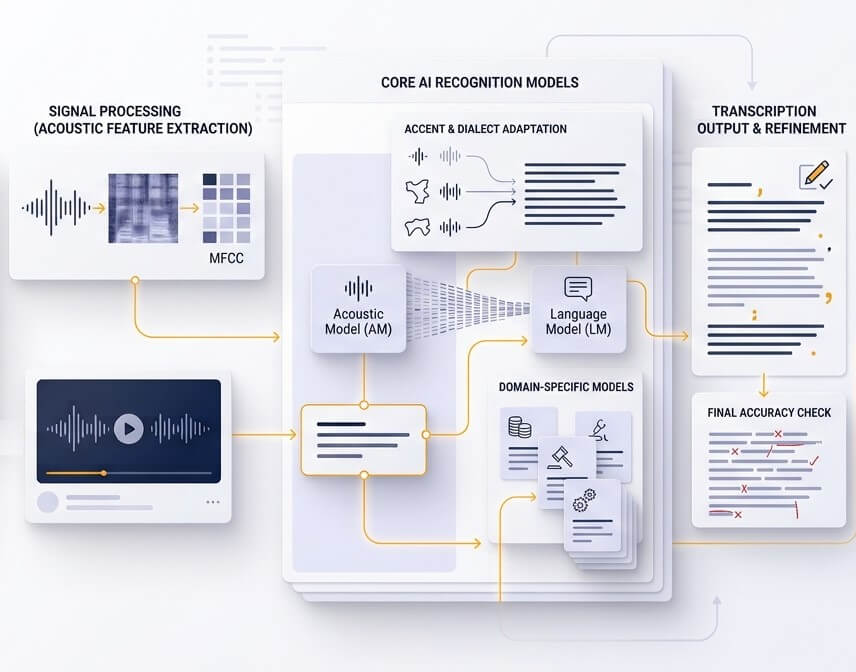
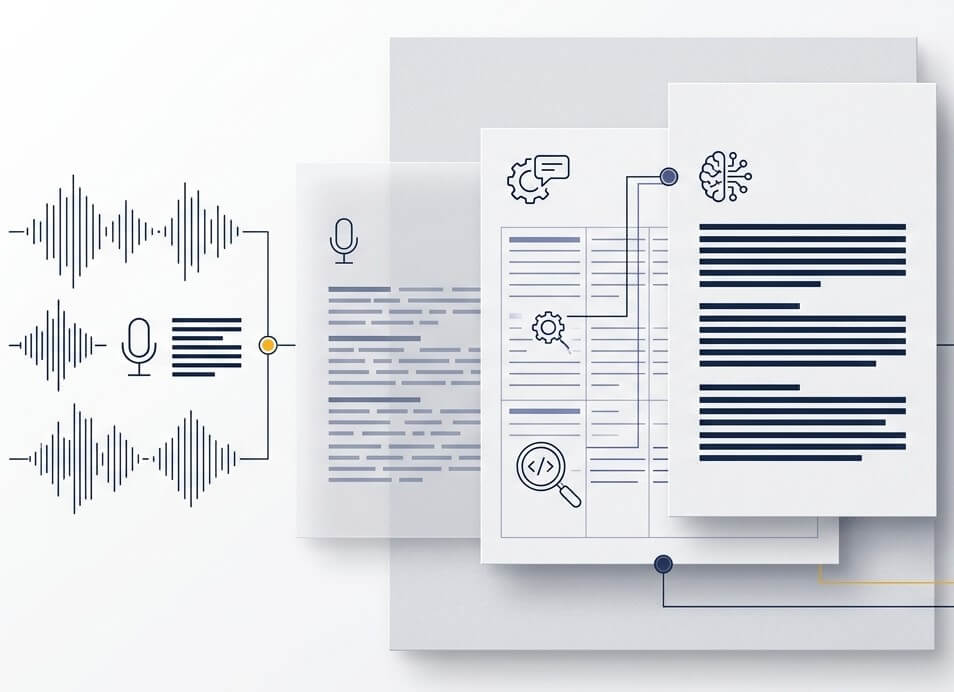
Useful text does more than repeat spoken words. Timestamps help return to the source, speaker labels make discussions easier to follow, and export options let teams reuse approved material in reports, captions, and notes. Keep the recording with the final transcript when accuracy matters, especially for research, legal, medical, or public-facing work.
Accuracy depends on the recording. A clean, single-speaker file with a good microphone usually needs much less editing than a call with background noise, overlapping voices, or unfamiliar names. Review the transcript before publishing it or using it for legal, academic, medical, or financial decisions. Time codes make it easy to verify important lines against the original audio.
Yes. Upload the Dutch recording, select English as the required output, and create a text version for international readers. Review proper names, company names, addresses, and Dutch expressions before distribution, since these details may need a preferred English spelling or explanation.
Files are transferred over encrypted connections and managed through account controls. Projects can be removed from the workspace when they are no longer needed. Before uploading regulated, confidential, or highly sensitive material, review the current privacy policy and retention terms, then apply the organization’s own approval process.
New accounts can use a free trial to test Dutch transcription on a real recording before choosing a plan. Available trial credits and any file limits are shown during sign-up, making it possible to assess audio quality and editing needs first.
Yes. Process the Dutch video, review the transcript, and export an SRT subtitle file for a video editor or publishing platform. Subtitle quality improves when the spoken language is clear and the final text has been checked for names, punctuation, and line breaks.
A professional Dutch transcriber is valuable when a recording is difficult to hear or the final document must meet a formal standard. This includes legal evidence, publication-ready interviews, complex medical discussions, archival work, and recordings with several overlapping speakers. Automated transcription can still save time by providing a searchable first draft for human review.