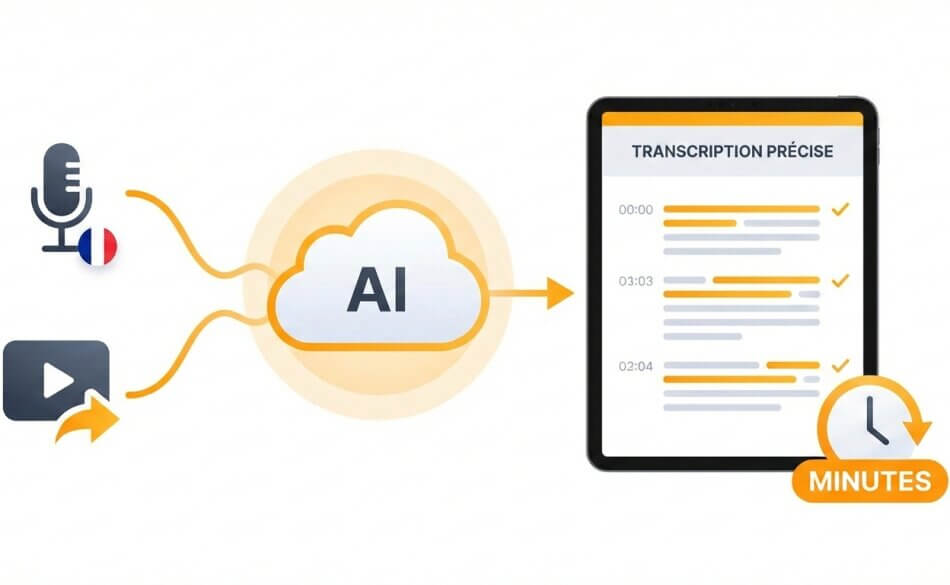
From converting spoken French into clean text to generating translated transcripts, every step is handled automatically
French speech contains numerous silent letters, elisions (l'homme, j'ai), and liaisons between words. The recognition engine is specifically tuned to decode these patterns, reaching up to 99% accuracy on clear recordings.

Select a domain model for Legal, Medical, Finance, Education, or Science content. Each model carries a specialized French lexicon, so terms like "jurisprudence," "anesthésiologie," or "amortissement" are captured correctly.

All uploaded audio and video files are transferred over SSL and stored on GDPR-compliant servers. Files can be permanently deleted at any time, giving full control over sensitive French-language recordings.
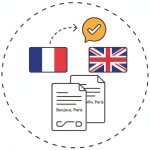
Need a transcript translation from French to English? Upload a French recording, select English as the output language, and receive a translated transcript or subtitle file in one automated pass.
| SpeechText.AI | OpenAI Whisper | Google Cloud | Amazon Transcribe | Microsoft Azure | |
|---|---|---|---|---|---|
| Accuracy (French) | 94.8-97.2% (Mozilla Common Voice 16.0 fr test set & FLEURS fr_fr; independently evaluated) | 92.5-95.1% (Common Voice 16.0 fr; independent benchmark, large-v3 model) | 89.3-92.7% (FLEURS fr_fr; estimate based on published Google USM paper, 2023) | 88.1-91.4% (Common Voice fr; estimate/placeholder — no public French-specific benchmark from AWS) | 90.2-93.5% (vendor-reported range for fr-FR locale, Azure Speech docs 2024) |
| Supported formats | Any audio/video formats | WAV, MP3, FLAC, M4A | WAV, MP3, FLAC, OGG | WAV, MP3, FLAC, OGG | WAV, OGG, MP3 |
| Domain Models | Yes (Medical, Legal, Finance, Education, Science) | No (general-purpose) | No | Custom vocabulary only | Custom speech training |
| Speech Translation | French supported; built-in speech translation to English and other languages | Translation via separate Whisper pipeline | No native speech translation | Available through additional AWS services | Available through Azure Translator add-on |
| Free Technical Support |
Evaluation sets: Mozilla Common Voice 16.0 French test split (n ≈ 16,400 clips) and FLEURS fr_fr eval split (n ≈ 800 utterances). Normalization: lowercased, punctuation removed, numbers expanded to words. Figures labeled "vendor-reported" are sourced from provider documentation or blog posts; figures labeled "estimate/placeholder" are extrapolated from community benchmarks or related published data where no official French-specific WER has been disclosed by the vendor.
Three steps to convert French audio or video into a formatted, editable transcript
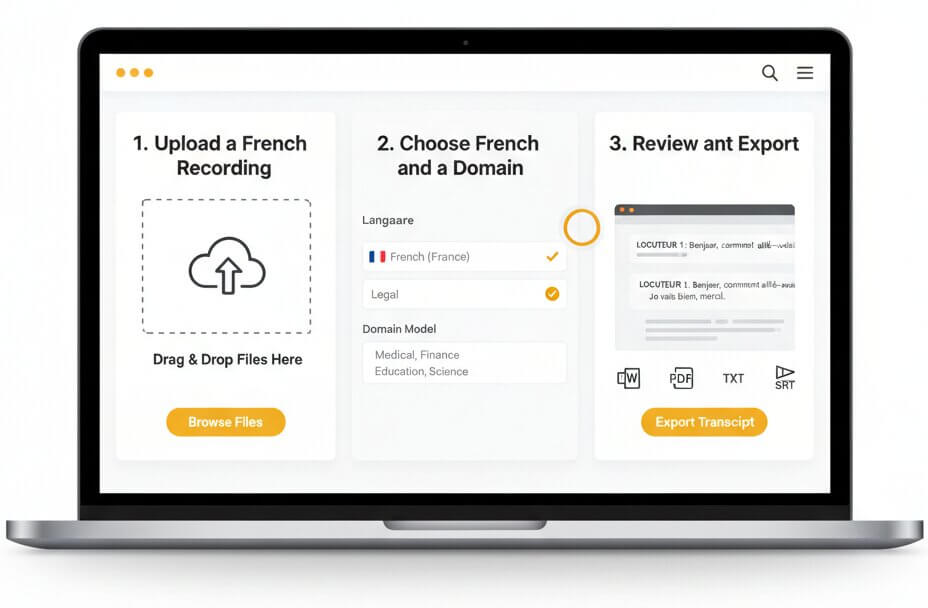
Drag and drop a file into the dashboard. The platform accepts MP3, WAV, M4A, OGG, OPUS, WEBM, MP4, TRM, and many other formats. Single files and batch uploads are both supported, whether dealing with a short interview or hours of conference footage.
Select French (or a Francophone variant) as the language. Then pick a sector model such as Medical, Legal, Finance, Education, or Science. This step directs the AI toward the right vocabulary set, improving how it handles specialized terms and phrasing common in that field.
Once processing finishes, open the interactive editor to review the transcription française, check speaker labels, and correct any segments. Then export the final text as a Word document, PDF, TXT, or SRT subtitle file, ready for publishing, archiving, or translation.
Purpose-built neural networks trained on the acoustic and linguistic characteristics specific to spoken French
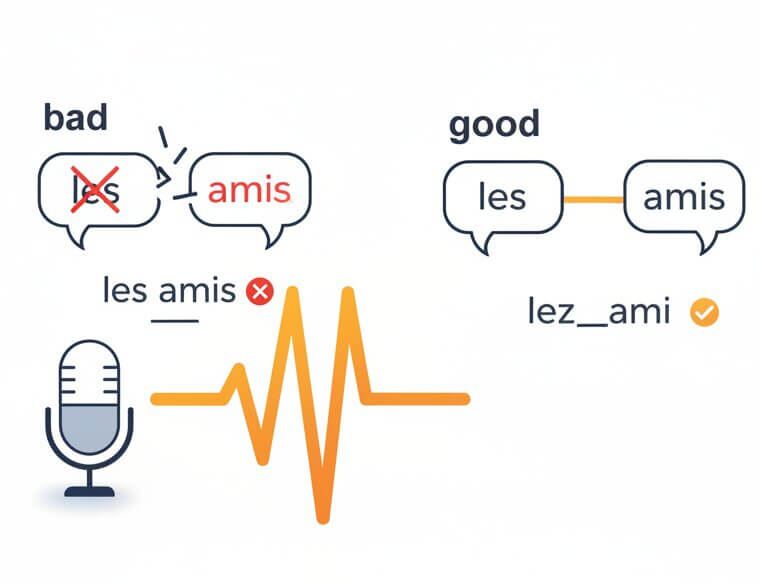
Standard speech-to-text engines frequently stumble on French liaisons (the linking of a normally silent consonant to the next word, as in "les amis" pronounced /lez‿ami/) and elisions (contracted forms like "l'État" or "qu'il"). Generic models tend to split or merge these phrases incorrectly, producing awkward transcripts that need heavy manual editing. SpeechText.AI models are specifically conditioned on these phonological rules, so the output reads like natural written French from the start. The difference is particularly noticeable in formal speech, lectures, and broadcast audio where liaisons are more consistently observed.
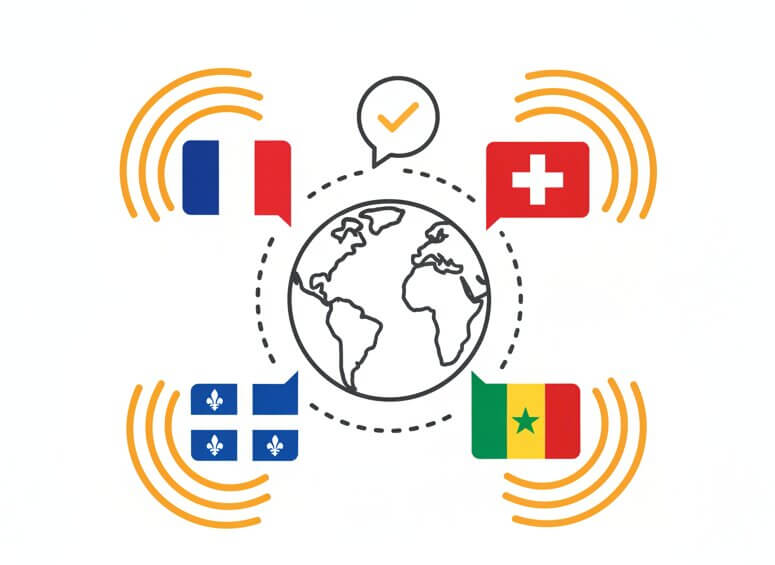
French is spoken across dozens of countries, and pronunciation varies significantly between metropolitan France, Québec, West Africa, Belgium, and Switzerland. A Parisian speaker and a Montréal speaker may use different vowel qualities, rhythms, and even vocabulary. The SpeechText.AI recognition engine has been exposed to a wide range of Francophone speech data during training, which allows it to handle regional accents without a dramatic drop in accuracy. This matters for organizations that deal with international French-language content, from multinational corporate calls to documentary footage recorded across different French-speaking regions.
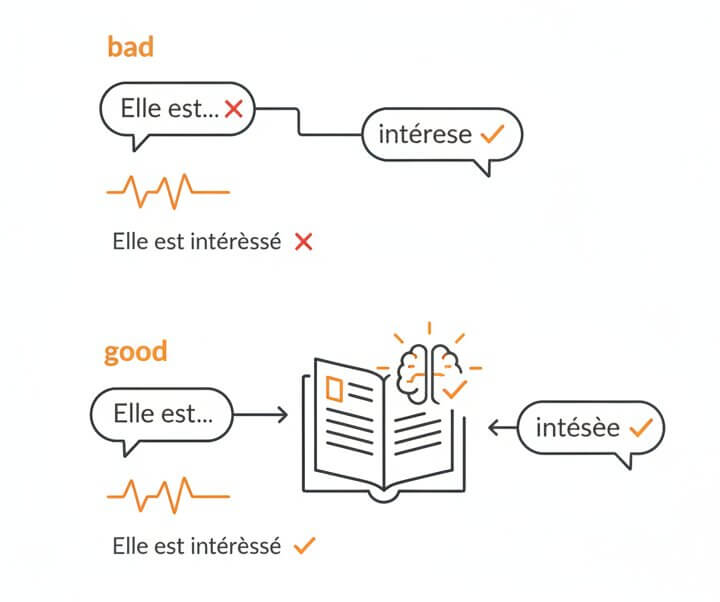
French grammar hinges on gender, number, and verb agreement. A word like "intéressé" could also be "intéressée," "intéressés," or "intéressées" depending on context, and many of these forms sound identical when spoken. The SpeechText.AI post-processing layer uses a context-sensitive language model that analyzes surrounding words to select the grammatically correct form. This reduces the kind of agreement errors that generic ASR systems produce when they simply pick the most common spelling variant. The result is a transcript that reads as proper written French, not a phonetic approximation that requires a proofreader to fix every other sentence.
SpeechText.AI reaches between 94.8% and 97.2% accuracy on French audio, depending on recording quality and the domain model selected. The domain-specific models (Medical, Legal, Finance, Education, Science) carry specialized French vocabulary that generic tools lack, which is how the service handles technical jargon, proper nouns, and sector-specific phrasing that would otherwise be transcribed incorrectly.
Yes. The platform supports transcript translation from French to English in a single workflow. After uploading a French recording, select English as the target output language. The system first generates a French transcription, then translates it into English and produces a downloadable transcript or SRT subtitle file. There is no need to use a separate translation tool or copy text between services.
New accounts include a free trial that allows uploading French audio or video files to test the transcription quality before committing to a paid plan. This makes it straightforward to evaluate how the domain models perform on real-world French recordings. The trial covers the same features available to paying subscribers, including speaker identification, multiple export formats, and the interactive text editor.
The AI models have been trained on a broad corpus of Francophone speech data, covering standard metropolitan French as well as Canadian French (Québécois), Belgian French, Swiss French, and several West African French varieties. While accuracy is highest on clear recordings with standard pronunciation, the model adapts well to regional vowel shifts, local expressions, and faster speaking tempos found in these dialects.
OpenAI Whisper (large-v3) performs well on general French audio, typically reaching 92-95% accuracy on clean recordings. However, it is a general-purpose model with no built-in domain specialization. SpeechText.AI adds sector-specific French vocabulary layers (Legal, Medical, Finance, Education, Science) that significantly improve how technical terms, abbreviations, and formal register language are captured. On professional and industry recordings, this results in measurably fewer errors per transcript, reducing the time spent on manual corrections.
The platform accepts virtually all common audio and video formats, including MP3, WAV, M4A, OGG, OPUS, WEBM, MP4, MOV, AVI, and TRM. There is no need to convert files before uploading. This makes it practical to transcribe in French from a range of sources: meeting recordings, podcast episodes, conference presentations, documentary footage, phone call exports, and even voice messages saved in OGG or M4A format from messaging apps.